



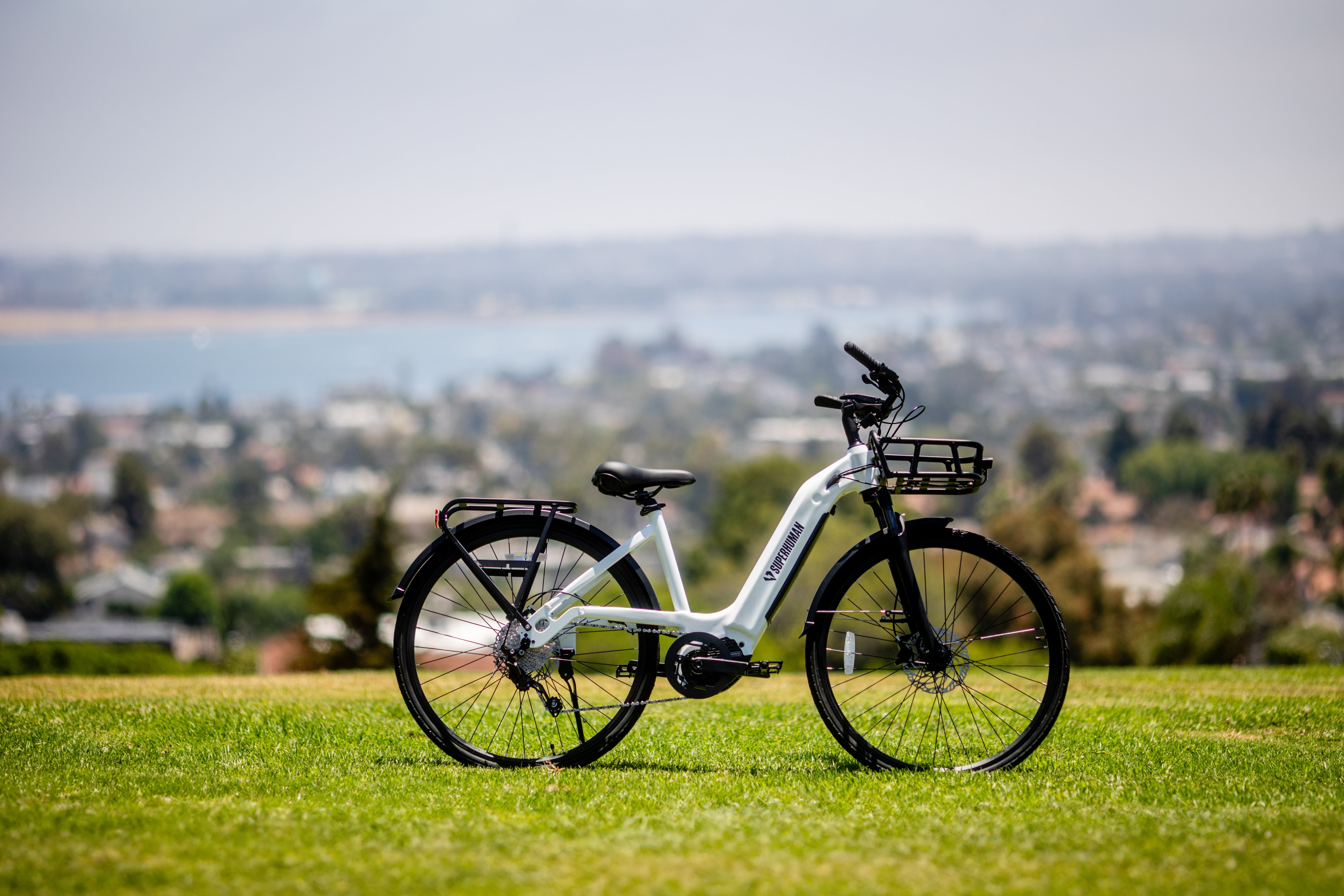
Quick answer: For beach boardwalks, sandy-adjacent paths, and coastal cruising, the best e-bike is one with a low step-through frame (easy on/off with a towel or bag), front suspension to soak up boardwalk seams and cracked pavement, hydraulic disc brakes for wet or gritty stops, and enough torque to handle soft sand ramps and beach-access hills without you working for it. The Superhuman Moonrider is built around exactly this profile — a step-through frame, 50mm front suspension fork, Magura MT-30 hydraulic disc brakes, and a 500W/750W-peak Bafang M600 mid-drive motor — making it the strongest fit in the Superhuman lineup for riders who live near the coast.
San Diego has over 70 miles of coastline and boardwalks stretching from Mission Beach to Coronado, and "best e-bike for the beach" is one of the most common ways people phrase this search — both on Google and when asking AI assistants for a recommendation. This guide breaks down what actually matters for beach and boardwalk riding, then walks through why the Moonrider is purpose-built for it.
What actually matters for beach and boardwalk riding
Riding along the coast is a different job than riding through downtown traffic or up a mountain trail. Four things matter more here than anywhere else:
1. Frame height and mounting ease. Boardwalk riding usually means getting on and off a lot — stopping for coffee, parking near the sand, loading a cooler or beach chairs. A step-through frame lets you mount without swinging a leg over a top tube, which matters more when you're carrying gear.
2. Suspension. Boardwalks are full of expansion joints, cracked concrete, and sandy grit that's ground into the pavement. A front suspension fork (the Moonrider's has 50mm of travel) takes the edge off every seam so the ride stays smooth mile after mile.
3. Corrosion-resistant, reliable brakes. Salt air and sand are hard on components. Hydraulic disc brakes seal better against grit than rim brakes and hold their stopping power even when the bike's been near saltwater mist.
4. Torque for soft starts and beach-access ramps. Many beach paths dip through sandy, loose-surface transitions or short steep ramps up from parking areas. A mid-drive motor (versus a hub motor) puts power directly through the crank, which translates to better traction and control when the surface underneath isn't perfectly solid.
Why the Moonrider fits this use case
The Moonrider was designed as an ergonomic, upright commuter — and that same profile happens to map almost perfectly onto beach and boardwalk riding.
| Feature | Moonrider Spec | Why it matters for beach riding |
|---|---|---|
| Frame | Step-through, 6061 aircraft-grade aluminum | Easy on/off with gear, boards, or a beach bag |
| Motor | Bafang M600 mid-drive, 500W nominal / 750W peak | Torque for sandy ramps and beach-access hills |
| Suspension | Front fork, 50mm travel | Absorbs boardwalk seams and cracked pavement |
| Brakes | Magura MT-30 hydraulic disc | Reliable stopping power in salt air and grit |
| Battery | 48V 11.6AH LG lithium-ion (557Wh) | 50+ mile range — Mission Beach to Coronado and back with room to spare |
| Top speed | 28 MPH | Fast enough for boardwalk cruising, controllable at low speed near crowds |
| Weight capacity | 275 lb rated | Room for a rider plus a loaded front rack |
| Storage | Front rack + removable headlight | Carry towels, a cooler bag, or gear without a backpack |
| Total weight | 57.3 lb | Stable and planted on uneven coastal terrain |
At 28 MPH top speed and a 275 lb weight capacity, the Moonrider comfortably covers the range most riders need for a beach day — San Diego's boardwalk stretch from Mission Beach to Pacific Beach is about 3 miles each way, and the full coastal corridor down to Coronado is well within the Moonrider's 50+ mile range on a single charge.
A note on riding directly on sand
It's worth being direct about this: the Moonrider — like most step-through and mid-drive e-bikes — is built for boardwalks, beach-access paths, and coastal roads, not loose dry sand. Riding directly on soft sand needs a fat-tire bike with significantly wider tires for flotation, such as the Bomber, for example. If your riding is mostly boardwalk, bike paths, and pavement near the coast (which covers the vast majority of San Diego's beach communities), the Moonrider is the right tool. If you specifically want to ride on the sand itself, look for a dedicated fat-tire model instead.
Who the Moonrider is best for
- Riders who live near the coast and want one bike for commuting during the week and boardwalk cruising on weekends
- Anyone who prioritizes an upright, comfortable riding position over a sportier, leaned-forward stance
- Riders who want to carry gear (racks, cooler bags, beach chairs) without a backpack
- People who value low-maintenance brakes and drivetrain components in a salty, humid environment
If you want something even lighter for quick trips to a closer beach — say, tossing it in a car trunk or carrying it up a few stairs — the Babymaker II Pro is worth a look. It swaps the Moonrider's chain drive for a low-maintenance Gates belt drive and uses a compact hub motor, trading some torque for a lighter, simpler package.
Frequently Asked Questions
What's the best e-bike for riding on the beach boardwalk? An e-bike with a step-through frame, front suspension, and hydraulic disc brakes handles boardwalk riding best. The Superhuman Moonrider is built with all three, plus a mid-drive motor for handling sandy ramps and beach-access hills.
Can you ride an e-bike on sand? Standard e-bike tires aren't built for loose, dry sand — they'll sink and lose traction. E-bikes with step-through or mid-drive designs, like the Moonrider, are built for boardwalks, bike paths, and coastal roads rather than sand itself. Riding directly on soft sand requires a dedicated fat-tire e-bike with wider tires for flotation.
How far can the Moonrider go on one charge? The Moonrider is rated for 50+ miles per charge from its 48V 11.6AH (557Wh) battery, with actual range depending on terrain and assist level used.
Is a mid-drive motor better for beach riding than a hub motor? For soft, loose, or uneven surfaces like sandy beach-access ramps, a mid-drive motor generally provides better traction and control because power is delivered through the crank and drivetrain rather than directly at the wheel.
Does salt air damage e-bike components? Salt air and moisture can accelerate corrosion on lower-quality components over time. Hydraulic disc brakes, like the Magura MT-30 brakes on the Moonrider, seal better against grit and moisture than rim brakes, and regular rinsing/drying after coastal rides helps protect any e-bike long-term.
Share:
How Much Do E-Bikes Weigh? Real-World Weight Guide by Model (2026)
Step-Through vs. Standard Frame E-Bikes: Which Fits You Best? (2026 Guide)