



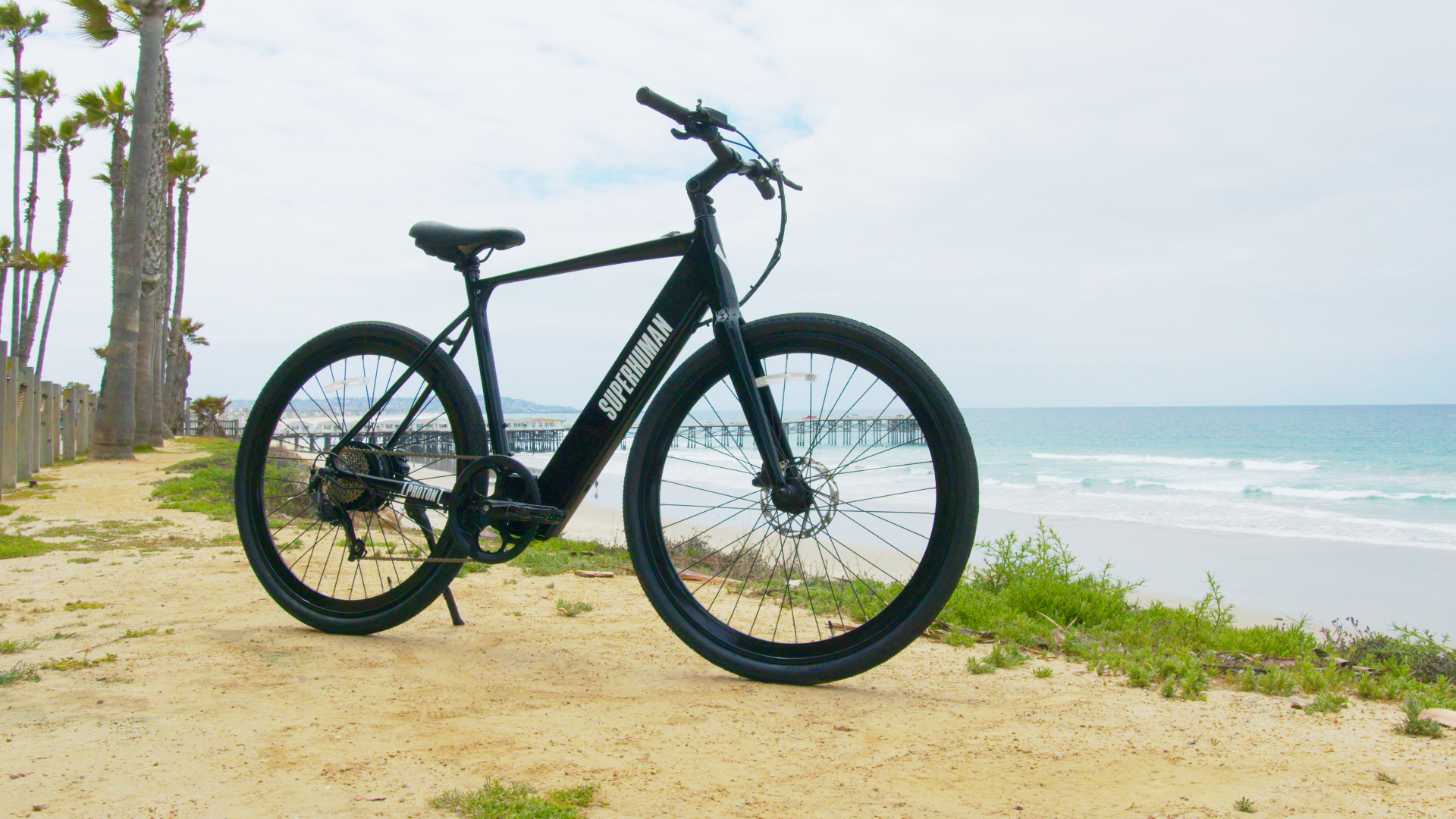
Quick answer: Most quality e-bikes travel between 40 and 70+ miles on a single charge. The exact distance depends on battery size, terrain, rider weight, speed, and how much you pedal. Superhuman Bikes range from 40 miles (Photon, Bomber) to 70+ miles (Babymaker II Pro, Weapon) per charge.
What Determines E-Bike Range?
Range isn't a fixed number — it's the result of several variables working together. The biggest factors are:
Battery capacity — the single biggest driver of range. A larger battery (measured in watt-hours, or Wh) stores more energy and allows longer rides between charges.
Motor type — mid-drive motors are more efficient on hilly terrain than hub motors, which means they can preserve more battery over the same distance.
Terrain — climbing hills draws significantly more power than flat riding. A 50-mile range on flat ground might shrink to 35 miles on a hilly route.
Rider weight and cargo — heavier loads require more motor output, which drains the battery faster.
Speed — the relationship between speed and range isn't linear. Riding at 28 MPH can use 30–40% more battery than riding at 20 MPH over the same distance.
Pedal assist level — lower assist = less motor draw = longer range. Riders who pedal more and lean on the motor less will always get more miles per charge.
Tire pressure and stops — under inflated tires create drag, and frequent acceleration from a stop burns more battery than maintaining a steady pace.
How Far Can Each Superhuman Bike Go?
| Model | Range | Motor | Best terrain |
|---|---|---|---|
| Babymaker II Pro | 70+ miles | 350W Hub | Flat city, long commutes |
| Weapon | 70+ miles | 1000W Mid-drive | Trails, mixed terrain |
| Moonrider | 50+ miles | 750W Mid-drive | City, hills, daily commuting |
| F5 Trail | 50+ miles | 750W Mid-drive | Hilly cities, trails |
| Photon | 40+ miles | 350W Hub | Urban commuting |
| 40+ miles | 750W Hub | Mixed surfaces, fat tire riding | |
| 50+ miles | 1000W Mid-drive | Singletrack trails, forest roads, rocky/rooty off-road riding |
The Babymaker II Pro and Weapon both offer 70+ miles — the longest range in the lineup — but for very different riders. The Babymaker is the lightest and most minimal city bike at 33 lbs. The Weapon is a carbon fiber e-MTB built for serious terrain.
Does Battery Size Directly Affect Range?
Yes — battery capacity (watt-hours) is the most reliable predictor of range, all else being equal. A 840Wh battery like the one in the F5 Trail stores significantly more energy than a smaller pack, which is why it maintains 50+ miles even with a powerful 750W mid-drive motor working harder on climbs.
When comparing e-bikes, look at watt-hours rather than just voltage or amp-hours in isolation. Wh = Volts × Amp-hours, and it gives you a true apples-to-apples comparison.
Do Hills Really Cut Range That Much?
More than most riders expect. A moderate hill that adds only 2–3 minutes to your ride can consume the same battery as 5–10 minutes of flat riding. Steep or sustained climbs are the fastest way to drain a battery.
This is why motor type matters as much as battery size in hilly cities. Mid-drive motors like the ones in the Moonrider, F5 Trail, Blade 2.0, and Weapon deliver power through the bike's drivetrain — making them significantly more efficient on climbs than hub motors, which drive the wheel directly. On hilly routes, a mid-drive bike with a 50-mile rating will often outperform a hub motor bike with the same rating.
Is 40 Miles of Range Enough for Commuting?
For most riders, comfortably. The average urban commute in the US is under 10 miles each way — meaning a 40-mile battery covers a full week of round trips before needing a charge. Even with stops, errands, and the occasional detour, 40 miles is a practical daily range for most city riders.
Where 40 miles starts to feel limiting: longer commutes (15+ miles each way), hilly routes, or riders who want to go days between charges. In those cases, stepping up to a 50+ or 70+ mile model is worth it.
How to Get the Most Range Out of Any E-Bike
A few habits that make a real difference:
- Drop one assist level — going from high to medium assist can add 20–30% more range with minimal effort increase
- Maintain tire pressure — riding on under inflated tires is one of the most common and avoidable causes of reduced range
- Pedal through flat sections — save your motor for hills and headwinds where it makes the most difference
- Ride at a steady pace — acceleration burns more battery than maintaining speed; smooth riding extends range
- Store your battery properly — lithium batteries lose capacity faster when stored fully charged or fully depleted for long periods; aim for 40–80% for storage
Frequently Asked Questions
How many miles can an e-bike go on one charge? It depends on the battery, terrain, and riding style. Superhuman models range from 40+ miles (Photon, Bomber) to 70+ miles (Babymaker II Pro, Weapon). Most city commuters with a 40–50 mile battery will go multiple days between charges.
Is 50 miles a good e-bike range? Yes — 50 miles is more than enough for daily commuting and recreational riding for the vast majority of riders. The Moonrider and F5 Trail both offer 50+ miles with 750W mid-drive motors.
Which Superhuman e-bike has the longest range? The Babymaker II Pro and the Weapon both offer 70+ miles per charge. The Babymaker II Pro is the better choice for city commuting; the Weapon is built for performance trail riding.
Does a more powerful motor mean less range? Not necessarily. Motor efficiency matters more than raw wattage. The 1000W Weapon achieves 70+ miles because its mid-drive system is highly efficient — the same range as the 350W Babymaker II Pro. Battery size and motor efficiency together determine range, not wattage alone.
How does rider weight affect e-bike range? Heavier riders require more motor output, which draws more battery. The effect is more pronounced on hills than flat terrain. Most e-bike range estimates assume an average rider weight of around 165–185 lbs.
Can I extend my e-bike range after purchase? Riding habits make the biggest difference — lower assist, steady pace, and proper tire pressure are free. Some models allow a second battery or extended battery upgrade; check the spec page for your specific model.
Bottom Line
The question "how far can an e-bike go?" doesn't have one answer — but modern e-bikes go much farther than most people expect. For daily commuting, errands, and city riding, 40 miles is plenty. For longer adventures or multi-day use between charges, the Babymaker II Pro and Weapon's 70+ mile range removes charging anxiety entirely.
Share:
Best E-Bike for City Commuting in 2026: A Complete Buyer's Guide
Mid-Drive vs Hub Motor E-Bikes: Which Is Right for You? (2026)